
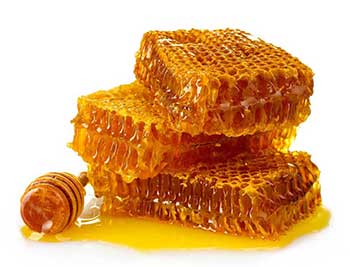
Manuka Honey
We source premium quality honey and honey related products from Australian beekeepers.
Members of the AMHA
We support world leading scientists in honey research and development, including education, analysis and validation.
Our honey is carefully filtered to eliminate contaminants, while maintaining product integrity to deliver optimal health benefits.
Source
Our sources of honey come from beekeeping families all over Australia, primarily located along our pristine eastern coastline.
Our unique native flora and fauna and untouched natural landscapes create ideal conditions for delicious natural honey free from all pesticides and preservatives.
We source 100% Australian varieties of honey, including Manuka, Eucalyptus and Tea Tree.

Manuka and the science behind it
Scientists have discovered that the organically occurring compound methylglyoxal (MGO) is directly responsible for Manuka Honey’s antibacterial activity. MGO results from dihydroxyacetone (DHA), a natural compound in the Manuka flower nectar.
We use MGO as a recognised marker of antibacterial activity.

Why Manuka?
Whilst all honey possesses some degree of medicinal power, none is as efficient at killing superbugs and stimulating healing as Manuka. Australia’s untouched coastal bushland is home to over 80 species of Leptospermum, the plant that gives Manuka honey its natural antibacterial properties.
Our hot and humid climate and unique natural landscape create ideal conditions for producing delicious, high potency Manuka.
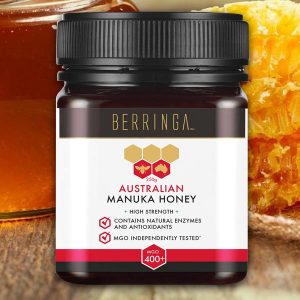
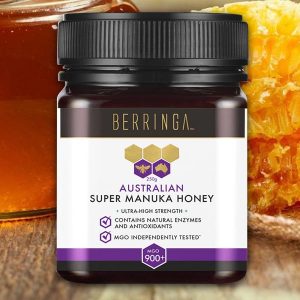
Our Manuka Range
All Manuka has some degree of antibacterial activity.
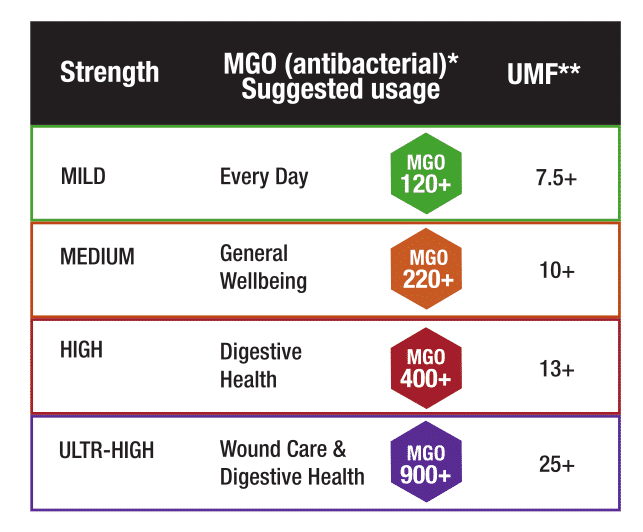
Berringa uses the proven and globally recognised MGO measurement to indicate varying antibacterial strengths. All Berringa Manuka is Independently tested and verified through (Australian Government) NATA certified laboratories.
One of the most common is MGO (or methylglyoxal). MGO is a globally recognised measure of antibacterial activity. Another system you might see referred to on jars of honey is “UMF” (a scheme created in New Zealand).
If you are confused by the numbers on the outside of a jar though, the chart below provides a useful summary of the MGO to “UMF” conversion – so you can easily translate the antibacterial strength for yourself.